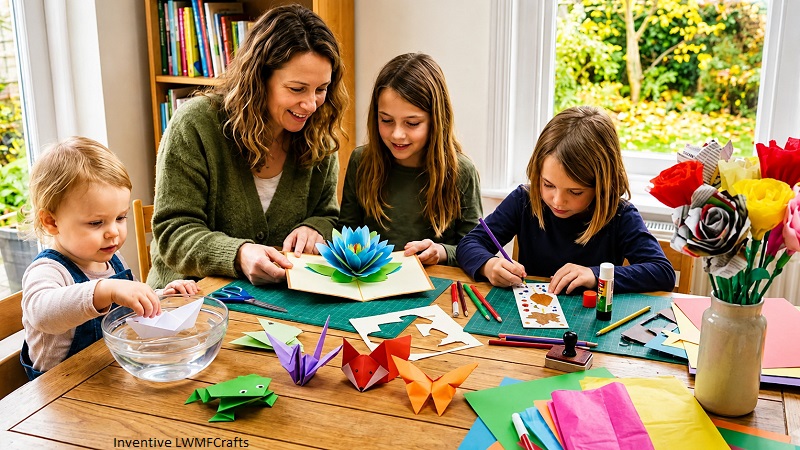
At first, I made my DIY craft project on a kitchen table that had crayon marks and scattered grains of food on it. I was then a new mother and completely tired and looking for something that was just mine. Something creative and soothing that was outside the routine.
My first project was nothing special, but it lit something inside me that has not gone out to this day. Today, my three children have grown up, but there are still grains of something or other scattered on the kitchen table. In sixteen years, I have made many projects, taught my children to make things with their own hands, and learned more about creativity, patience, and resourcefulness than I ever expected. Today I want to share with you everything this journey has taught me, from the best beginner projects to the techniques that actually make a difference, all rooted in the spirit of inventive lwmfcrafts.
What inventive lwmfcrafts actually are
Inventive crafts go beyond following a set of instructions to recreate something you saw online. It is to look at an ordinary and wasted thing and ask what it can become, not what it already is. A cereal box is not just recycling. A tin can is not just packaging. A worn-out pair of jeans is not just old cloth. Inventive crafting is the skill in which you see creativity where others see nothing.
As a mother, I have found a lot of strength in this approach because it meant that I could use things already present in my home to make crafts. No need to buy expensive supplies, no need to order special things. Just creativity applied to the everyday materials already sitting on my shelves and in my recycling bin.
This is the spirit of inventive lwmfcrafts, combining resourcefulness with genuine creative thinking to produce work that is personal, practical, and often surprisingly beautiful.
Materials you already have at home
The first thing I tell beginners in crafting is that there is no need to buy new material; just look at what you already have at home. These materials are most useful in creative DIY projects and are often already available at home.
Glass jars and bottles: These are the most commonly used items in any crafter’s collection. I have turned jars into vases, lanterns, storage containers, candle holders, and centerpieces. This material is present in almost every home. My kids grew up watching me rinse out pasta sauce jars and set them aside.
Cardboard and cereal boxes: Cardboard is thick and strong, and it is very useful, and mostly found at home, so it is completely free. By cutting and folding it, picture frames, gift boxes, and craft projects can be made. Cereal boxes are already found at home and are also used in multiple projects.
Fabric scraps: You can also collect fabric scraps. When clothes become old, instead of wasting them, add them to your collection. And from these scraps you can make wall hangings, cushion covers, patchwork art, and birthday party bunting. I have also tried this from my fabric scrap collection.
Tin cans: Cleaned tin cans are perfect for planters, pencil holders, lanterns, and bathroom organizers. And these are also easily available.
Old wood: Pieces of wood are a great base for painted signs, memo boards, and decorative trays.
DIY craft projects worth trying at home
Tin can lanterns: Fill a tin can with water and freeze it, then use a hammer and nails to punch patterns on the sides. When the ice melts, and a tea light is placed inside, the effect is magical.
Fabric scrap wall hanging: Cut fabric scraps into strips and tie or weave them onto a piece of driftwood or a thick garden stick. Mix textures and colors. These make the home more beautiful.
Cardboard desk organizer: Cut a cereal box into different heights and arrange it inside a larger box, then cover it with kraft paper. These are completely free, and I made them for my children’s study tables.
Denim planter pockets: Cut the legs of old jeans and sew or staple the bottom part, fill it with soil, and hang it on a garden fence. Everyone notices them and likes them.
Some important techniques
Use of Mod Podge: This is a glue, sealer, and finish all in one product. Always apply it in thin layers and let it dry completely. Rushing is the most common mistake.
Painting tips: For glass and tin, first apply spray primer. For beginners, chalk paint is the best option because it is easy to apply and gives a matte finish.
Outdoor projects: Always seal outdoor items with a waterproof sealant. I also learned this when I saw many of my things get damaged in the rain.
Crafting tips for busy families
As a mother, I know how difficult it is to find time. These things really helped me.
Keep your materials visible. On my kitchen counter, there is a basket where I put jars, fabric scraps, and cardboard. Seeing it daily keeps ideas active in the mind. You can also make such a basket where you collect things, then new ideas will start coming from it.
Instead of the whole day, start with just 15 to 20 minutes and begin small projects that come to your mind.Make things with your children together as family activities; it is truly enjoyable.
Why making things by hand is important.
We live in a world where everything can be ordered, and things I have made with my own hands hold a value that purchased things can never have. I remember every handmade thing in my home, and those memories remain preserved in those things forever.
The spirit of inventive lwmfcrafts has given me this. And if you allow yourself to start, even imperfectly, just with a jar and some twine, it will give you something lasting as well.